Learn how to buy unlisted shares in India step-by-step. Understand risks, benefits, platforms, taxation, and expert tips with real-life practical insights for beginners and traders.
How to Buy Unlisted Shares – Complete Beginner’s Guide
Buying stocks before they get listed on the stock market sounds exciting, right?
A few years ago, I also got curious when I heard people talking about companies like NSE, OYO, and Chennai Super Kings before their IPO launch. Some investors were quietly buying these shares early and making huge profits after listing.
At first, I honestly thought unlisted shares were only for rich investors or insiders. But after researching, speaking with brokers, and observing how the grey market works, I realised that even beginners can learn how to buy unlisted shares safely — if they understand the process properly.
In this guide, I’ll explain everything simply and practically.
You’ll learn:
- What unlisted shares are
- How to buy unlisted shares step-by-step
- Risks and hidden mistakes beginners make
- Best platforms and brokers
- Taxation rules
- My personal observations and practical learnings
If you are a beginner or trader looking for early investment opportunities, this article will help you understand the real side of the unlisted market.
Why Most Beginners Get Confused About Unlisted Shares
The Biggest Confusion Around Unlisted Stocks
When people search for how to buy unlisted shares, they usually face one big problem:
There is very little trustworthy information available online.
Most YouTube videos only talk about profits and “multibagger opportunities.” Very few people explain the risks, practical buying process, documentation, lock-in concerns, or liquidity issues.
I personally noticed this when I first researched unlisted shares.
Everywhere I looked, people were only discussing:
- “Buy before IPO”
- “Huge returns coming”
- “Next Tata opportunity”
But nobody explained:
- Where exactly to buy?
- How are prices decided?
- Is it legal?
- What if no buyer is available later?
- Can beginners trust dealers?
This creates fear and confusion.
Common Problems Beginners Face
Here are some real beginner mistakes I have observed:
| Problem | Reality |
|---|---|
| Buying from unknown brokers | Risk of fraud |
| Expecting quick profits | Unlisted shares need patience |
| Ignoring company fundamentals | High chance of losses |
| Investing all money in one company | Dangerous strategy |
| Not understanding taxation | Unexpected tax burden |
Many beginners also assume that every unlisted company will eventually launch an IPO.
That’s completely false.
Some companies stay unlisted for years.
Some never get listed.
Some businesses even fail before IPO.
That’s why learning how to buy unlisted shares safely is more important than simply chasing hype.
Emotional Side of Investing in Unlisted Shares
One thing I learned personally is that unlisted investing is highly emotional.
When you hear stories like:
- “Someone bought NSE shares early and made lakhs”
- “Pre-IPO investors earned massive returns”
…it becomes easy to feel FOMO.
I made this mistake initially, too.
I almost invested in a trending unlisted company just because everyone on Telegram groups was talking about it. Later, after checking financials properly, I realised the business had weak revenue growth.
That experience taught me something important:
Hype and investment are two different things.
What You Will Learn From This Guide
By the end of this article, you will clearly understand:
- What unlisted shares actually are
- How to buy unlisted shares legally in India
- Best ways to avoid scams
- Important documents and requirements
- How taxation works
- Risks vs rewards
- How experienced investors analyse pre-IPO companies
- Smart strategies beginners can follow
I’ll also share practical observations from my own learning journey, along with common mistakes people should avoid.
This guide is written for real beginners — not finance experts.
So even if you are completely new to the stock market, you’ll understand the process step by step.
Understanding the Unlisted Share Market
What Are Unlisted Shares?
Unlisted shares are stocks of companies that are not listed on stock exchanges like the:
- National Stock Exchange
- Bombay Stock Exchange
These shares are traded privately through dealers, brokers, investment platforms, or direct transactions.
Some companies are:
- Planning an IPO
- Still growing privately
- Large but not publicly traded
Examples of popular unlisted companies that investors often discuss:
- National Stock Exchange of India
- OYO Rooms
- Boat
Why Investors Buy Unlisted Shares
The main attraction is the early opportunity.
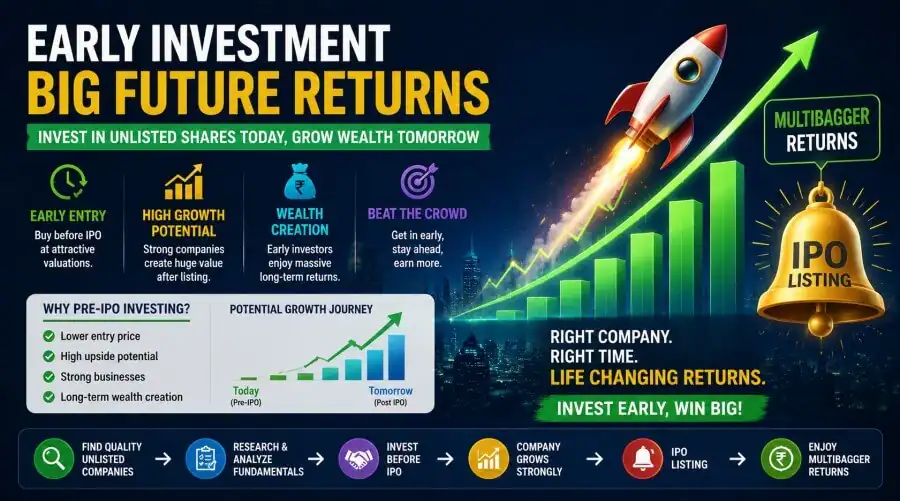
People invest hoping:
- The company grows rapidly
- IPO valuation increases
- Share prices rise after listing
This is similar to investing early in startups.
However, a higher reward usually means a higher risk.
Growth of Pre-IPO Investing in India
Over the past few years, interest in unlisted shares has increased rapidly because:
- More IPOs are launching
- Retail investors are becoming aware
- Financial influencers discuss pre-IPO investing
- Digital investment platforms are growing
During my research, I noticed that many investors now actively search for:
- “Best unlisted shares”
- “Pre IPO shares”
- “How to invest before IPO”
This trend is especially popular among young traders looking for high-growth opportunities.
How Prices Are Decided in Unlisted Shares
Unlike listed stocks, unlisted shares don’t have live market prices.
Prices depend on:
- Demand and supply
- Company valuation
- Financial performance
- IPO expectations
- Dealer network pricing
This creates price variation.
I observed that the same unlisted share can sometimes trade at different prices on different platforms.
That’s why comparison is important.
Is Buying Unlisted Shares Legal?
Yes, buying unlisted shares is completely legal in India.
But transactions must happen through proper channels.
Shares should transfer to your:
- Demat account
- With proper documentation
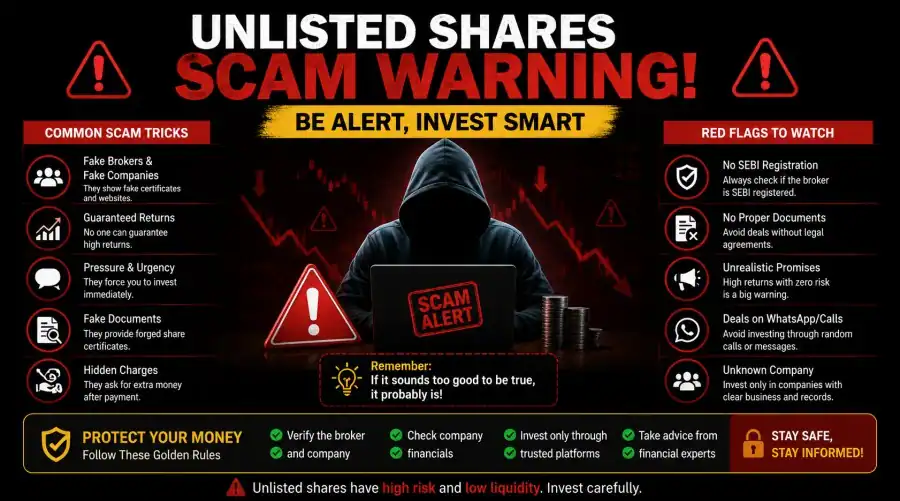
Never deal only through WhatsApp screenshots or verbal promises.
Risks of Investing in Unlisted Shares
This is the part many influencers ignore.
1. Liquidity Risk
Selling unlisted shares is difficult.
Sometimes buyers are unavailable for months.
2. Transparency Issues
Private companies may not disclose detailed public data regularly.
3. Fraud Risk
Fake dealers and manipulated pricing exist.
4. IPO Delay
A company may postpone IPO plans for years.
5. Valuation Risk
Many unlisted companies trade at inflated valuations.
My Personal Observation About Risk
When I first started studying unlisted investing, I thought “pre-IPO” automatically meant guaranteed profit.
But after observing multiple companies, I realised:
- Some companies grow strongly
- Some stay stagnant for years
- Some lose investor interest completely
This changed my mindset from:
“Quick profit investing”
to
“Business quality investing”
That’s the biggest mindset shift beginners need.
Step-by-Step Guide on How to Buy Unlisted Shares
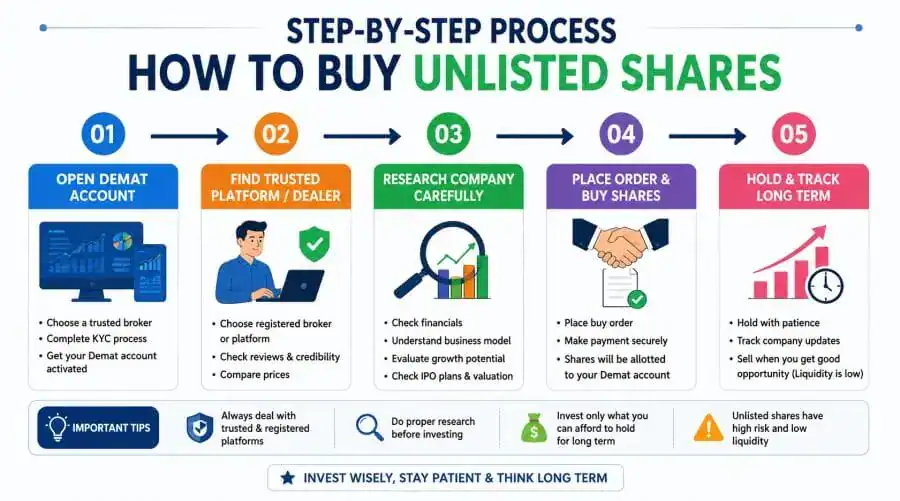
Step 1 – Understand Your Risk Capacity
Before buying anything, ask yourself:
- Can I hold shares for 3–5 years?
- Am I comfortable with low liquidity?
- Can I handle temporary losses?
If your answer is no, avoid unlisted investing.
Personally, I never recommend putting emergency money into unlisted stocks.
Step 2 – Open a Demat Account
To buy unlisted shares, you need:
- PAN Card
- Aadhaar Card
- Active bank account
- Demat account
Popular brokers in India include:
Even though unlisted shares trade privately, delivery still happens in Demat format.
Step 3 – Find Trusted Unlisted Share Dealers
This is the most important step.
You can buy through:
- Specialized brokers
- Pre-IPO platforms
- Wealth management firms
- Existing shareholders
Some known platforms include:
But always verify:
- GST details
- Reviews
- Company registration
- Payment process
Step 4 – Research the Company Properly
Never buy based only on hype.
Check:
- Revenue growth
- Profitability
- Debt
- Future business model
- IPO possibility
- Industry growth
Important Metrics to Analyse
| Factor | Why It Matters |
|---|---|
| Revenue Growth | Business expansion |
| Profit Margin | Financial health |
| Debt Level | Risk assessment |
| Management | Leadership quality |
| Industry Demand | Future opportunity |
Step 5 – Compare Share Prices
One thing I learned practically:
Prices vary heavily.
Before buying:
- Compare across platforms
- Check the latest transactions
- Understand valuation
Sometimes investors overpay due to excitement.
Step 6 – Complete Payment and Documentation
After confirming the deal:
- Make payment through banking channels
- Receive transaction confirmation
- Wait for shares to transfer into the Demat account
Usually, the transfer takes:
- 24 hours to several days
Avoid:
- Cash transactions
- Informal deals
- No-document investments
Step 7 – Hold With Patience
This is not intraday trading.
Most successful unlisted investors:
- Wait years
- Focus on strong businesses
- Ignore short-term noise
Best Strategies for Beginners
Start Small
My recommendation:
- Start with a small allocation
- Learn practically
- Understand liquidity first
I have seen beginners invest huge amounts emotionally and regret it later.
Diversify Your Investments
Never invest all your money in one unlisted company.
Instead:
- Combine listed + unlisted investments
- Diversify sectors
- Reduce risk exposure
Focus on Business Quality
Good businesses survive.
Weak businesses disappear.
Simple rule:
Invest in companies, not market hype.
Avoid Telegram “Tips”
This is extremely important.
Many fake operators create artificial demand.
I personally observed some groups aggressively promoting unknown companies with unrealistic targets.
Be careful.
Taxation on Unlisted Shares in India
Capital Gains Tax
Short-Term Capital Gains (STCG)
If sold before 24 months:
- Taxed as per slab rate
Long-Term Capital Gains (LTCG)
If held more than 24 months:
- 12.5% LTCG tax (subject to prevailing tax rules)
Tax rules may change, so always verify with a CA before investing.
Mistakes Beginners Must Avoid
1. Investing Without Research
Biggest mistake.
2. Chasing IPO Rumours
Not every company launches an IPO.
3. Ignoring Liquidity
Selling is difficult.
4. Overinvesting
Keep allocation limited.
5. Trusting Social Media Blindly
Always verify independently.
Real-Life Example of Practical Thinking
Let’s say two companies are available:
| Company | Situation |
|---|---|
| Company A | Trending on social media |
| Company B | Strong revenue growth but less hype |
Most beginners choose A.
Experienced investors often choose B.
That’s because sustainable business matters more than excitement.
This was one of the biggest investing lessons I personally learned after studying pre-IPO investing deeply.
Future of Unlisted Shares in India
In my opinion, the unlisted market in India will continue growing because:
- The startup ecosystem is expanding
- IPO participation is increasing
- Retail investors want early opportunities
- Financial awareness is rising
However, regulation and transparency will become increasingly important.
Investors who focus on:
- Research
- Patience
- Business quality
…will likely perform better over the long term.
Personal Opinion & Experience
After spending time researching and observing unlisted investments, I believe one thing very strongly:
Unlisted shares are not “quick money.”
They are high-risk, high-reward opportunities that require patience and business understanding.
At the beginning, I was mainly attracted by profit stories.
But over time, I realised that successful investors focus more on:
- Fundamentals
- Management quality
- Industry growth
- Long-term holding
One personal mistake I almost made was buying based purely on social media hype. Thankfully, deeper research saved me from investing emotionally.
My honest observation is:
- Good unlisted investments can create wealth
- Bad unlisted investments can trap money for years
That’s why beginners should:
- Start slowly
- Learn continuously
- Avoid emotional decisions
- Never ignore risk management
If used wisely, unlisted investing can become a valuable part of a diversified portfolio.
But discipline matters more than excitement.
FAQs – How to Buy Unlisted Shares
Is buying unlisted shares safe?
Yes, if purchased through trusted dealers and after proper research.
Can beginners buy unlisted shares?
Yes, beginners can buy them through brokers or specialised platforms.
Do unlisted shares always give a profit after IPO?
No. Profit depends on company performance and market conditions.
How long should I hold unlisted shares?
Usually, investors hold them for multiple years.
Can I sell unlisted shares anytime?
Selling is possible, but liquidity is lower than that of listed stocks.
Are unlisted shares risky?
Yes, they carry a higher risk compared to listed shares.
Investment Disclaimer
The information provided in this article is for educational and informational purposes only and should not be considered financial, investment, or legal advice. Investing in unlisted shares involves high risk, low liquidity, and market uncertainty. Prices of unlisted shares can fluctuate significantly, and there is no guarantee of profit or IPO listing.
Before investing, readers should:
- Conduct their own research
- Verify company fundamentals
- Consult a SEBI-registered financial advisor or investment expert
- Understand taxation and legal implications
The author’s opinions and personal experiences shared in this article are based on individual observations and research and may not apply to every investor or market condition.
Always invest responsibly and only invest money you can afford to hold for the long term or potentially lose.